
Build a Beloit Resident Timeline
A sound address history separates ownership, occupancy, and changes to the building. Deeds name legal parties. Directories and census schedules can identify previous residents, including people who never held title. Maps and permits date the site itself. Start with the source closest to the period, then use another kind of record to test the result.
| Source | Years It Covers | Where Held | What It Shows |
|---|---|---|---|
| Real-estate index and images | Most scans to 1830; keys vary | Rock County Register of Deeds | Parties, instruments, dates, legal descriptions |
| Beloit city directories | Located years from 1858 into the 1930s | UW, BPL, BHS, Beloit History | Names, addresses, trades, household clues |
| Federal census | 1850-1950 public | National Archives and library databases | Households on one enumeration date |
| Telephone and criss-cross books | Selected 1911-1937 and 1980-1995 | Beloit collections and Library of Congress | Subscribers or occupants by address |
| Maps and permits | 1890 Sanborn; permit start unpublished | Library of Congress and Beloit City Hall | Building form, use, and work dates |
For recent decades, begin with the parcel, then deeds and city files. For older years, move among directories, census pages, maps, and newspapers. Mark each gap instead of treating a missing year as proof of a move.
Choose the starting record by question. A change in legal ownership belongs in the deed chain. A question about who occupied a house belongs in directories and census schedules. Physical alterations belong in permits, Sanborn sheets, plats, and photos. When the dates disagree, keep both findings until a source with stronger control over that fact resolves the conflict.
Fix the Beloit Address First
Use the Rock County Tax Database Search and confirm the City Assessor route because the county Real Property Lister excludes City of Beloit parcels. Save the situs address, parcel or Tax ID, legal description, subdivision, lot and block, owner, and retrieval date.
The tax screen below is the current entry point for parcel and historical tax information.
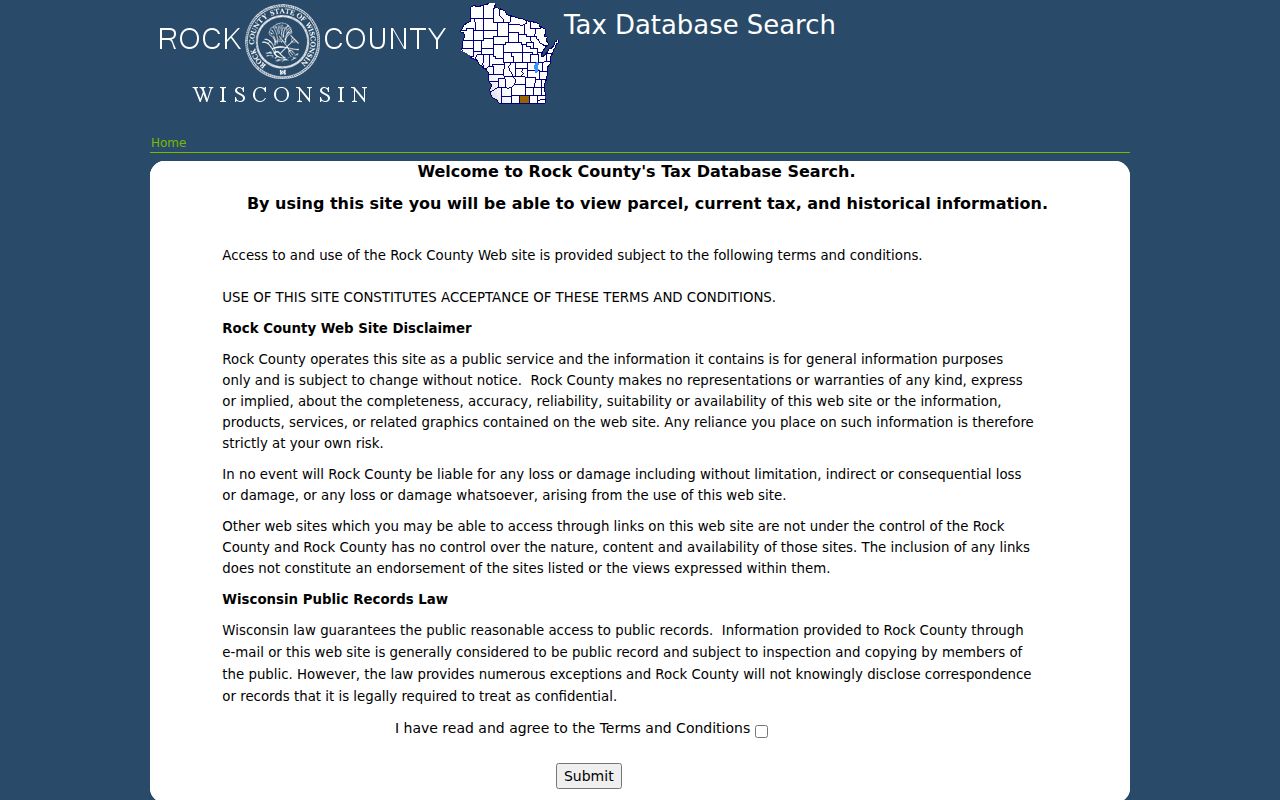
A parcel result is a bridge, not an occupant list. A tax mailing address can belong to an agent, business, or post office box. Check the Rock County GIS map near municipal edges because a Beloit postal address may fall outside the city.
Trace Rock County Owners Backward
With the present owner and legal description known, use the Register of Deeds search instructions. The grantor transfers an interest; the grantee receives it. Search today's owner as a grantee, then search the seller as an earlier grantee.
- Copy the owner, parcel ID, legal description, and subdivision details from the tax record.
- Find that owner as grantee. Open the deed image and record its grantor, date, document number, book and page.
- Search the grantor as a grantee in an earlier period. Test spelling variants and middle initials.
- Follow the same legal description and prior-instrument references. Do not label every quitclaim or trust deed as a sale.
- When online keys stop, ask the Janesville counter about deed books, tract indexes, and microfilm.
- Grantor and grantee
- The party giving an interest and the party receiving it.
- Chain of title
- The linked series of recorded transfers for the same property interest.
- Legal description
- Land language that identifies a parcel even when its street number changes.
Three Beloit Deed Cutoffs
Rock County says most real-estate records are scanned back to 1830. Document-number searches reach that far, while grantor, grantee, and document-type searches begin in 1956. Legal-description searching begins in 1978. The index is not address- or parcel-keyed.
Tapestry costs $8.75 per search plus $1 per image page; Laredo is the subscription route. County instructions warn of omissions and spelling errors. Search several ways and inspect the image. The Register of Deeds counter at 51 South Main Street in Janesville is open weekdays from 8:00 a.m. to 4:30 p.m.
Best evidence. An index hit is only a pointer. The document image supplies the parties, instrument, legal description, and earlier references.
Beloit House History Help
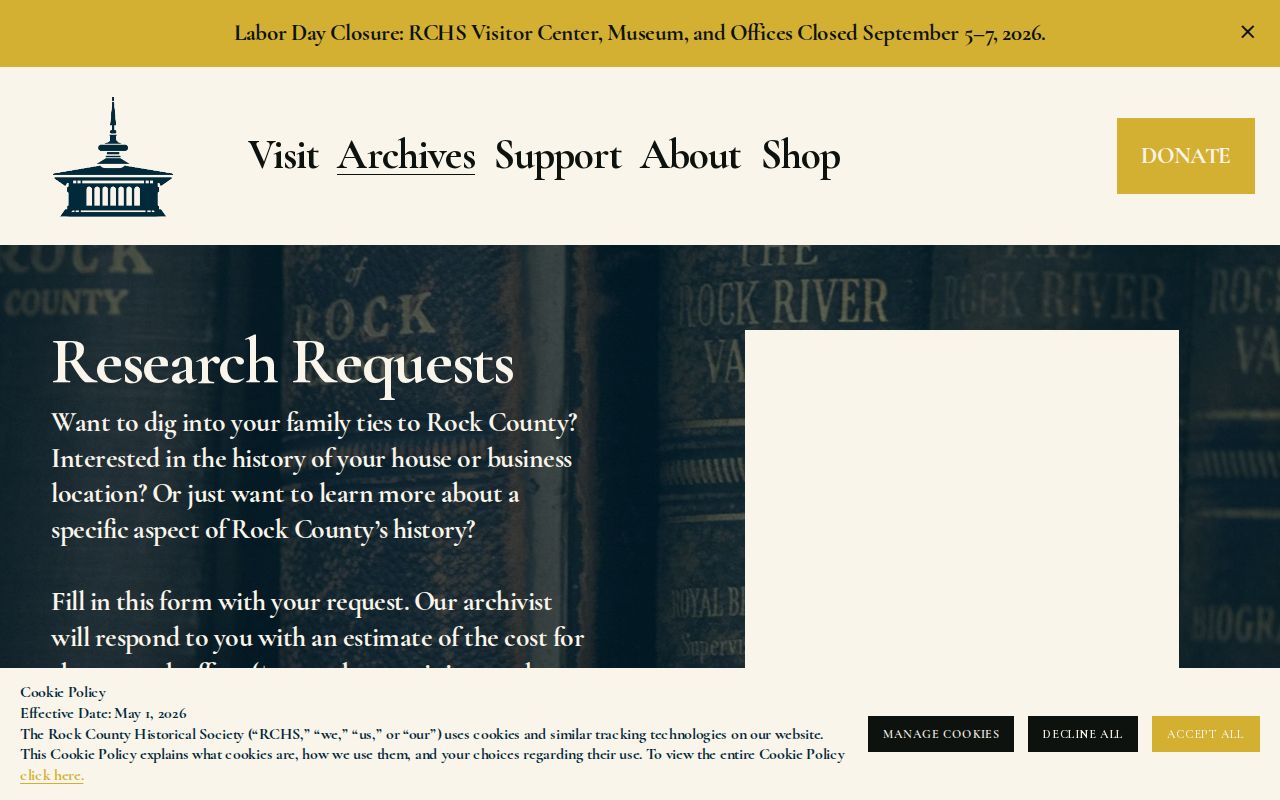
Rock County Historical Society accepts house, family, and business-location research. Send the present address, any old number, parcel ID, date range, and a clear question. Research is estimated at $40 per hour with a $25 minimum.
The captured request page below shows the local service that can bridge archive and address evidence.
Ask for citations and copies where possible. Beloit Historical Society adds plats, maps, Sanborn sheets, directories, newspapers, photos, yearbooks, cemetery records, obituary clippings, and staff files on people and buildings.
Match Old Beloit Street Numbers
The December 1890 Beloit Sanborn map has eight sheets showing footprints, uses, and fire-related construction. Pair it with a nearby directory, plat, and deed description. The map does not provide a complete household list.
Beloit uses the Rock River as its east-west numbering line and a 20-foot unit. The Town of Beloit uses the state line and River as grid baselines. Annexation, renamed roads, and number changes can break a simple search. Preserve the old address as printed, then attach a modern parcel only after map or legal-description evidence agrees.
The state line creates another trap. Several historic books include both Beloit, Wisconsin, and South Beloit, Illinois. A household may remain in the same local area while moving into another state and another county record system. Read the geographic heading on every page. A joint title does not make all entries Wisconsin records, and a modern Beloit postal line does not settle the older jurisdiction.
Connect Beloit Past Households
Deeds reveal owners, not all previous residents. City directories can add a trade, address, widow notation, or boarding clue. Public federal census schedules through 1950 show a wider household on one date. Telephone books name subscribers. Janesville-Beloit criss-cross books from 1980 through 1995 put an address first.
- Choose the directory nearest the target date and search the name list and street section.
- Copy the spelling, initials, household marks, trade, address, title, year, and page.
- Check the closest public census and record its enumeration date, household members, ages, and birthplaces.
- Test prior and next directories for a move, then seek a deed or newspaper notice.
- Keep owners, renters, boarders, and phone subscribers distinct in the final timeline.
The 1858 business list was subscription-based. Phone books omit those without listed service. Census schedules appear only once per decade. Agreement between two independent sources is much stronger than one matching name. Details of the books are available on the Beloit city directory page.
Track uncertainty in a simple research log. Give each row a date, printed address, name as written, source title, page or document number, and the role supported by that source. Use “owner,” “directory resident,” “boarder,” or “phone subscriber” instead of the broad word “resident” when that is all the evidence proves. This keeps a likely match from hardening into a false fact as the timeline grows.
Date Changes at Beloit Addresses
Beloit Planning and Building requires permits for construction, repair, alteration, demolition, fences, and similar work. Request files by address, parcel, type, and date range. The archive's public start year was not established, so ask how far records reach.
Code cases and service-line notices can date city attention to a parcel. A 2025 notice covered addresses with lead, galvanized, or unknown private-side pipe material. It is infrastructure evidence, not a customer-name roll. Protected complainant or utility information may be withheld, and an absent permit does not prove no work occurred.
Finish a Beloit Resident Trail
Search local newspapers when a name vanishes. Beloit Public Library lists Beloit Daily News in NewsBank from 1996 and full-page archive access from March 2005. Wisconsin Historical Society records older titles, including the Beloit Free Press from 1848 through 1903, with title changes and issue gaps.
An obituary can name relatives, a cemetery, or a later city. Search Wisconsin Circuit Court Access for a probate index, then request a petition, inventory, notice, or accounting from the clerk. Restricted or sealed details remain unavailable.
Rock County's first courthouse burned in 1859. An early start date does not promise a continuous chain. Ask whether a missing volume survives as an original, reconstruction, abstract, or microfilm copy, and compare county, state, and local collections.
Historical vital indexes can add another checkpoint. Wisconsin Historical Society offers online pre-1907 birth, marriage, and death indexes, but the full records are on microfilm and copies are uncertified. Later certificates follow eligibility and identification rules. Use an index to test a date and county, then apply through the proper custodian only when the record and access rule fit the question.
A complete house history should end with a source list and clear limits. State where the deed sequence is continuous, where directory years are missing, and where an old street number remains uncertain. That distinction is especially important for Beloit previous residents because county offices sit in Janesville, city files remain at Beloit City Hall, and some local books cross into Illinois. The strongest result explains both what the records show and what they cannot establish.
Lawful use. Research previous residents for house history, genealogy, estates, or personal curiosity. Never use an address trail to stalk, threaten, harass, or expose a living person.