
Map Beloit Directory Collections
Beloit's old directory shelf is scattered. Digital partners, local libraries, historical societies, and national collections each hold a piece of it. The Beloit Local History collection gathers scans from Beloit Public Library, the Beloit Historical Society, Beloit College, and University of Wisconsin partners. No unbroken annual run exists. Every title sets its own coverage rules. Business lists skip firms that did not subscribe, and phone books name subscribers rather than every person at an address.
| Collection | Years | Where Held | Access |
|---|---|---|---|
| Directory and Business Mirror | 1858 | UW digital sources and RCGS index | Online scan and index |
| Bailey and early Beloit volumes | 1862, 1895, 1897 | Wisconsin digital and library collections | Catalogs and scans |
| Osborne and later city volumes | 1900-01, 1902, 1904 | UW Digital Collections | Free page images |
| Beloit and South Beloit volumes | 1906, 1907-08, 1917 | UW and Beloit History partners | Digital collection |
| Telephone and Bell books | 1911; 1920, 1923, 1930-33, 1937 | Beloit History, BPL, and BHS | Digital or onsite |
| Janesville-Beloit criss-cross | 1980-1995 | Library of Congress inventory | Onsite request |
The library's resources page offers no complete year-by-year shelf list for the years after 1937. Ask staff for a target year. They can check city, telephone, Polk, McCoy, and reverse books when given a surname, a street, and a date range. The Beloit Historical Society works differently. Ask whether your item sits in the non-circulating Luebke Library or in a staff-accessible reference file.
Beloit Directory Publishers Through Time
Publisher swaps explain a lot. Format and population shift from book to book because different firms compiled each one. The 1858 Directory and Business Mirror traces to Smith, Du Moulin & Co. and Wright & Newcomb. Bailey's 1862 title blended a city record with business advertising. Osborne's 1900-01 book added churches, schools, societies, and organizations. It also carried a business section alongside the alphabetical name list. McCoy's 1917 volume covered Beloit and South Beloit together. Bell exchange books later centered on telephone subscribers.
| Year | Directory milestone |
|---|---|
| 1858 | Business Mirror and plat-based business directory appear. |
| 1900-01 | Osborne volume preserves names, addresses, civic groups, and businesses. |
| 1906-08 | Joint Beloit and South Beloit titles cross the state line. |
| 1924-33 | NARA lists Beloit city directories near the 1930 census. |
| 1980-95 | Janesville-Beloit reverse directories provide an address-first layer. |
A renamed title does not mean publication stopped. Search catalogs several ways. Try Beloit, South Beloit, Janesville-Beloit, telephone exchange, and the publisher's own name. Also copy the title page. A volume may carry a stamp with two years. But it may rest on a single survey date rather than two full resident counts. Treat the dates as one count until the title page says otherwise.
Note: Joint Beloit and South Beloit books need a Wisconsin or Illinois jurisdiction check. Verify that before you treat an entry as a City of Beloit address.
Search Beloit History Online
Digital scans beat a road trip for early volumes. The Beloit Local History collection holds city directories and telephone books. It also includes farm directories, plats, and local publications. Text search can miss a faint name or an old typeface. Fall back on the alphabetical pages. Street sections and page thumbnails rescue a search when optical character recognition fails.
The collection page displays the local digitization hub used for Beloit city directory research.
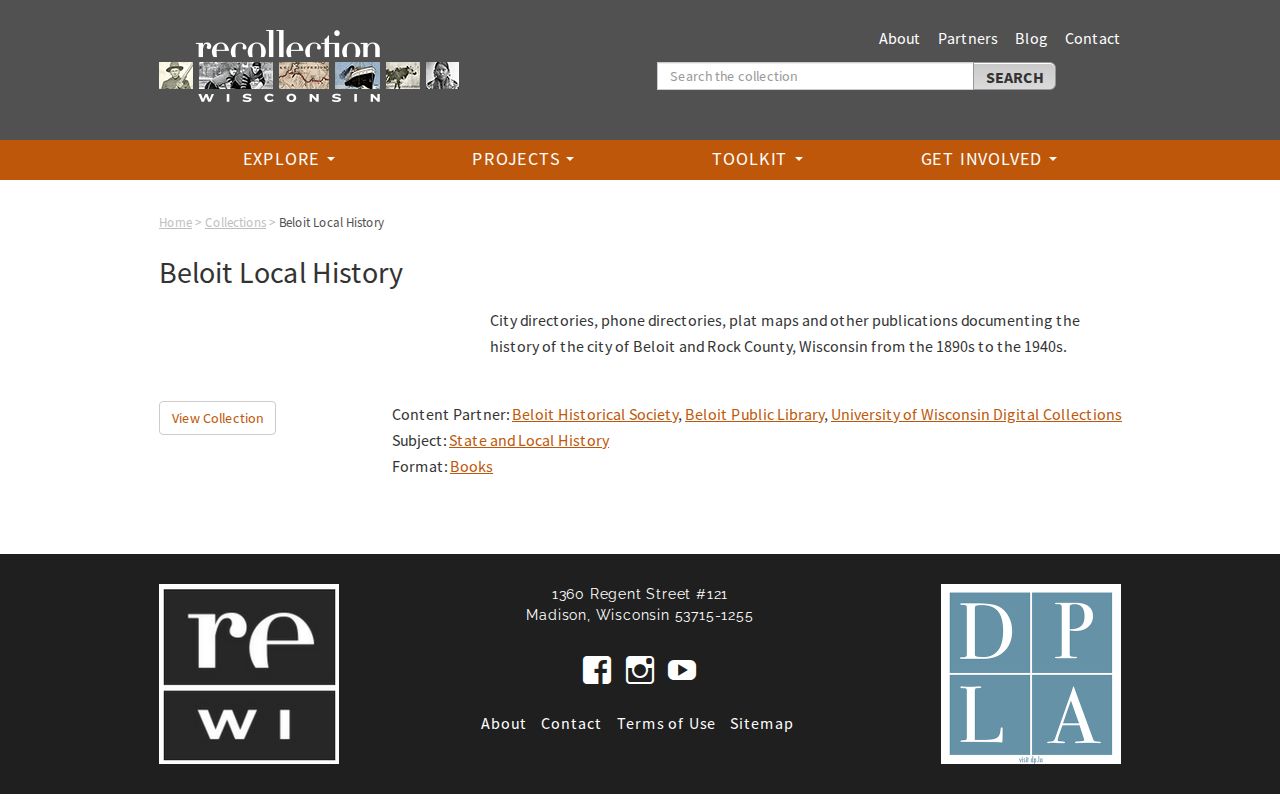
The digitization hub sits inside a wider local-history collection. Keep that scope in mind when you search. Open any item you use, and save its title, date, partner institution, page number, and stable record link beside each name found.
Decode a Beloit Directory Entry
A directory entry is compact. It is not a full life record. The Osborne 1900-01 scan shows an alphabetical name list plus editorial, business, church, school, society, and organization sections. Copy the printed form first. Expand initials or correct spelling afterward, then compare the title page and abbreviation key from that same volume, because conventions shift between publishers.
| Name string | Surname, given name, or initials exactly as printed. |
|---|---|
| Work line | Occupation or employer when the publisher supplied one. |
| Residence | Street and number, often introduced by res. |
| Household clue | A widow label, boarding mark, or cross-reference may connect people. |
| Civic entry | Church, school, society, or organization listing in a separate section. |
| Page context | Nearby entries and the section heading help prevent a false match. |
- Criss-cross directory
- A later address-first book arranged by street or telephone number rather than surname.
- Householder index
- A street-order list that points from a property address to the person named there.
- Abbreviation key
- The publisher's own list of shortened words, such as res for residence and bds for boards.
A work line alone proves nothing. Two residents can share initials and a trade. Match the address, any spouse or widow clue, and entries from nearby years before deciding the line belongs to one person.
The 1858 Beloit Roster
Beloit's 1858 business directory is both useful and easy to misread. It grew from a city plat map and grouped businesses. It was never a census. Subscription fees let some firms opt out. A partner might hide under the firm's main listing rather than his own name. Gaps in the publisher's group numbers also remain unexplained.
Later Rock County Genealogical Society indexers kept uncertain spellings. They suggested possible 1860 census forms for hard-to-read names. That caution helps. Search the original spelling, the variant, initials, and the business name. Never swap one for the other silently. That uncertainty may separate two look-alike residents.
Directory limit. Absence from a Beloit directory does not prove absence from the city. Publication scope, subscription, telephone service, and editorial choices all caused omissions.
Beloit Directory Research Desks
One desk covers a lot. The Beloit Public Library resource desk links local history, onsite Ancestry, HeritageQuest, Beloit newspapers, and the digitized Beloit History collection. Its databases carry names into census and newspaper evidence. Renovation has complicated visits. A July 2025 city notice said the genealogy section moved during project phases, so confirm the current shelf location and access before traveling. The library resource page displays the genealogy and local-history routes open to a Beloit directory searcher.
Not every volume sits online. Some years were never scanned. Ask staff three things. Can the book be viewed onsite, can a page copy be supplied, and is the year filed under a phone-book or publisher title rather than a city directory? Beloit Historical Society's Luebke Library offers much more. It adds telephone books, newspapers, atlases, plats, Sanborn maps, obituary clippings, cemetery material, and complete Beloit High School yearbooks. People, building, business, church, and organization files are staff-accessible and not fully cataloged online. Rock County Historical Society also handles family, house, and business-location research requests, at $40 per hour with a $25 minimum.
Beloit Directories Cross State Lines
Beloit sits beside South Beloit, Illinois. The 1906 and 1907-08 titles name both cities, and the 1917 McCoy volume does the same. A resident who seems to vanish may simply have crossed the state line without leaving the local community. Check the place heading first. Then read the street line. Attach a Wisconsin record only after that. Context often hides in industrial and college sources. Beloit College records can bridge students and alumni, and the Fairbanks Flats photo collection documents African American families who moved from Pontotoc, Mississippi, for Fairbanks Morse work. Yearbooks, church files, local photos, and employer-linked material can explain why a name first appears in a certain part of the city.
Trace Families in Beloit Directories
Follow a household in both directions. A Beloit city directory offers a tight local snapshot. The census gives a wider view. But it comes only once each decade, and public schedules now extend through 1950 under the National Archives' 72-year rule. Use the nearest census to test relationships, ages, birthplaces, and occupations, then return to directory years to narrow the timing of a move.
- Find the earliest likely entry and copy the name, initials, address, work line, year, and page exactly.
- Check the prior and next available books. Log each address or occupation change without guessing what caused it.
- Use a street-order or criss-cross section when available to test the same address and nearby names.
- Pair the entry with the closest public census schedule, noting that its facts apply to one enumeration date.
- Confirm a move or death through a deed, newspaper, probate file, cemetery record, or historical vital index.
A missing name can mean many things. The person moved, died, lacked a phone, boarded under another householder, used a different spelling, or fell outside the publisher's survey. Newspapers are the natural next stop. Beloit Public Library offers Beloit Daily News coverage from 1996 through NewsBank plus a full-page archive from March 2005. Wisconsin Historical Society holds older titles such as the Beloit Free Press, 1848 through 1903, with known issue gaps.
Cite every step. Record the directory title, publisher, nominal year, page, printed spelling, and repository. A census match needs its date and page. A newspaper needs its title and issue date. This small habit lets you revisit a faint scan, explain a correction, or show why two similar Beloit names were treated as different people.
For address-first research in later decades, the Library of Congress lists Janesville-Beloit and vicinity criss-cross books from 1980 through 1995. That word “vicinity” matters. Verify the municipality. Never assume every entry sits inside Beloit city limits. The full modern address workflow lives on the Beloit street directory page.